Stories about objects
The Mina McKenzie Kete was created by young Rongotea weaver, Cassandra Archer, in 2023. It is currently on display as part of Te Manawa’s exhibit: ‘Keeping the Taonga Warm – The Legacy of Mina McKenzie’. Historian Dr Tanja Rother spoke with Cassandra to find out the story behind the kete.
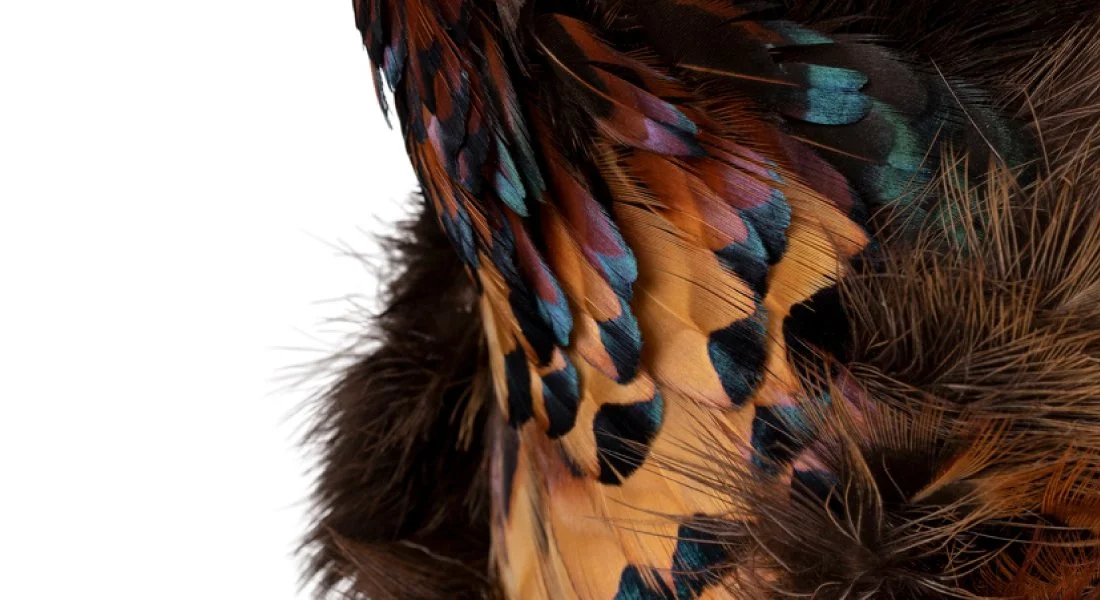
Mina McKenzie Kete, made with muka and pheasant pelt by Cassandra Archer (detail). Collection of Te Manawa Museums Trust.
A Basket of Knowledge
Cassandra Archer is a Manawatū weaver whose paternal whakapapa connects her to Rarotonga; her mother is New Zealand Pākehā. Though born in Auckland, Cassandra has made her home in Rongotea, alongside her husband and four children. It is from this home that she speaks to me on a Thursday morning in early autumn.
Thursday is Cassandra’s study day. She is currently working towards a Master of Museum and Heritage Practice (MMHP) at Te Herenga Waka Victoria University of Wellington. But today she is at home, surrounded by her family and the pā harakeke she has been nurturing for several years. The variety of harakeke that grows here is rich in muka fibre and now hard to find in the Manawatū, she tells me. The hundreds of plants on her land have become a resource for herself and other local weavers.
When we spoke, Cassandra expressed a sense of privilege that she can be a mother, a weaver, and study for the joy of it. But it was hard to get to this point. Cassandra’s eldest son was born when she was just 16, so putting food on the table for her family was a priority from a young age. She left school early.
It was not until she embarked on Maunga Kura Toi, the Bachelor of Māori Art in Raranga (Weaving) at Te Wānanga o Aotearoa that she really discovered her passion. What was initially “a way to get out of the house and meet other likeminded, creative wāhine,” turned out to be a second chance education. Before starting the degree, Cassandra said she was “absolutely hopeless, there was no way I could see a future or anything coming of that journey.” However, she persisted. Raranga skills developed naturally, enjoyment of the academic setting followed, and Cassandra discovered there was something special about drawing on mātauranga Māori to produce contemporary taonga.
”This whole journey for me has been passion-led.”
Upon completing her Bachelor’s degree, Cassandra enrolled in the MMHP programme so that she could learn the skills to care for, as well as create, taonga. When Mina McKenzie’s ‘keeping taonga warm’ came up in her course, the concept resonated straight away. For taonga to be kept warm, it must be in constant contact with tangata. The contact can be physical or intellectual: it’s about acknowledging the agency of the taonga and engaging with kōrero that draws mātauranga from taonga so that it can be carried into the present, passed on to the future.
At the time this kaupapa was introduced to her class, Cassandra had become fascinated by kākahu (garments) produced with pelts or animal hides. It’s a practice that is rare in contemporary raranga but was common in pre-colonial Aotearoa. Today, weavers wishing to develop a raranga practice that incorporates pelts must delve into museum collections if they are to access the ancient knowledge behind this technique. That’s exactly what Cassandra had been doing in 2023.
“It can be such a cold space out the back in [museum] collections.”
In visiting museum collections Cassandra found that as well as keeping objects at low temperatures for preservation, many lacked “a kaitiaki or […] iwi Māori input“ and so they were especially cold. As Cassandra’s research into Mina’s mahi and her own raranga began to intertwine, Mina and her kaupapa became increasingly important sources of inspiration. A bundle of muka that Cassandra started weaving in class to keep her hands busy soon became a pheasant pelt kete. As it took shape, so too did Cassandra’s vision of Mina as a role model. Upon completion, Cassandra felt it was only right to dedicate this new taonga to Mina because “a kete is full of knowledge and that’s Mina”.
The Mina McKenzie kete is now a permanent part of Te Manawa’s collection and Cassandra, too, has become a part of the museum’s team of kaitiaki. Together, tangata and taonga are advancing Mina’s vision for keeping our taonga warm.
Dr Tanja Rother is a historian, researcher and writer based in the Bay of Plenty | www.sharedlandscapes.com